Free Ski

Objective
| Difficulty | Description |
|---|---|
| 5/5 | Go to the retro store and help Goose Olivia ski down the mountain and collect all five treasure chests to reveal the hidden flag in this classic SkiFree-inspired challenge. |
Goose Olivia mission statement
“HONK! Well hello there! Fancy meeting you here in the Dosis Neighborhood.
You know, it’s the strangest thing… I used to just waddle around the Geese Islands going ‘BONK’ all day long. Random noises, no thoughts, just vibes. But then something changed, and now here I am—speaking, thinking, wondering how I even got here!
HONK! You know what happens to geese in a permanent winter? We can’t migrate! And trust me, being stuck in one place forever isn’t natural—even for someone who just discovered they can think and talk. Frosty needs to chill out… wait, that’s exactly the problem!
This game looks simple enough, doesn’t it? Almost too simple. But between you and me… it seems nearly impossible to win fair and square.
My advice? If you ain’t cheatin’, you ain’t tryin’. wink
Now get out there and show that mountain who’s boss!
Solution
This objective shifts from pure technical analysis to pattern recognition and perseverance within a constrained game environment. Although presented as a simple arcade-style challenge, success required careful observation of movement patterns, obstacle behavior, and reward placement rather than brute-force attempts. The exercise mirrors real-world problem solving where progress depends on adapting strategy, recognizing implicit rules, and maintaining focus through repeated failure.
The entire objective was solved using Kali Linux (WSL), using Python 3.13.
Extract Python Game
First I had to smuggle out the compile Python files from the .exe file. The hints for this objective already had given away that I was dealing with Python due to the tool references. First I had to set up the extractor:
git clone https://github.com/extremecoders-re/pyinstxtractor.git
python3 pyinstxtractor/pyinstxtractor.py FreeSki.exe
This tool extracted all pyc (compiled Python files) and placed them in a folder called FreeSki.exe_extracted. Once this was done, I moved on to decompilation step.
Decompiling using Decompyle++
The hints stated to use Pycdc. In order to use it I had to fetch it from Github and compile it:
git clone https://github.com/zrax/pycdc.git
cd pycdc
cmake .
make
The decompilation was … interesting. At first I tried to use pycdc, but it did not decompile the FreeSki.pyc file completeley. So I decided to try the ASM route instead:
pycdc/pycdas
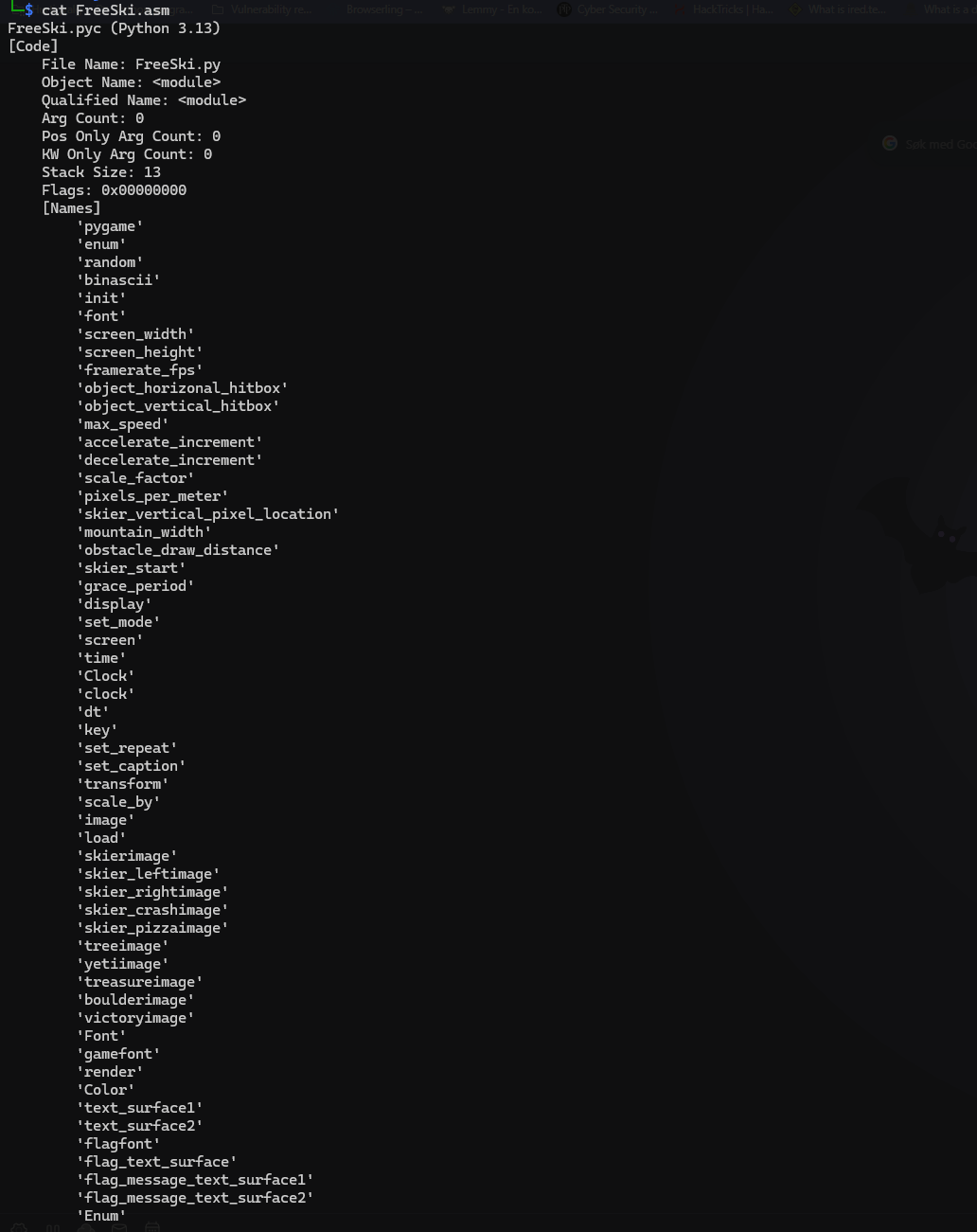
pycdc/pycdas FreeSki.exe_extracted/FreeSki.pyc > FreeSki.asm
This is a snippet from the FreeSki.asm file:
Finding the solution
From here I uploaded the FreeSki.asm to ChatGPT and asked what this file did - and I got this response:
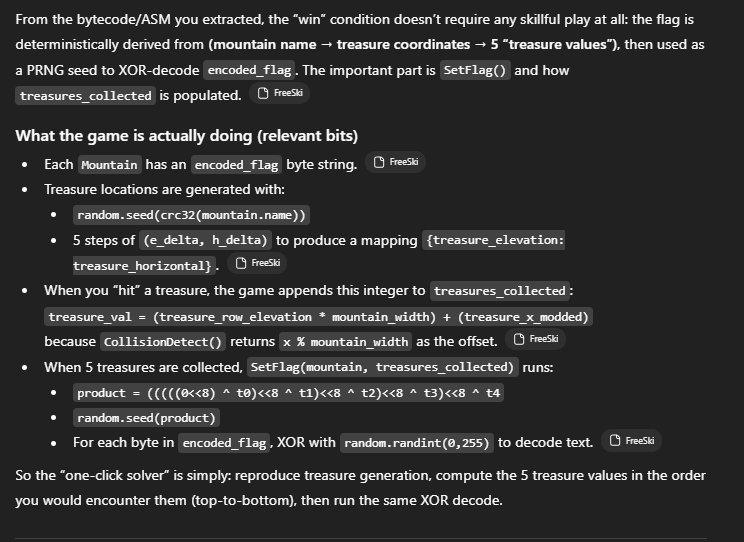
Then I asked ChatGPT to make a “one-click-resolver”:
#!/usr/bin/env python3
import random
import binascii

MOUNTAIN_WIDTH = 1000

MOUNTAINS = [
    ("Mount Snow",    3586,  b"\x90\x00\x1d\xbc\x17b\xed6S\"\xb0<Y\xd6\xce\x169\xae\xe9|\xe2Gs\xb7\xfdy\xcf5\x98"),
    ("Aspen",        11211,  b"U\xd7%x\xbfvj!\xfe\x9d\xb9\xc2\xd1k\x02y\x17\x9dK\x98\xf1\x92\x0f!\xf1\\\xa0\x1b\x0f"),
    ("Whistler",      7156,  b"\x1cN\x13\x1a\x97\xd4\xb2!\xf9\xf6\xd4#\xee\xebh\xecs.\x08M!hr9?\xde\x0c\x86\x02"),
    ("Mount Baker",  10781,  b"\xac\xf9#\xf4T\xf1%h\xbe3FI+h\r\x01V\xee\xc2C\x13\xf3\x97ef\xac\xe3z\x96"),
    ("Mount Norquay", 6998,  b"\x0c\x1c\xad!\xc6,\xec0\x0b+\"\x9f@.\xc8\x13\xadb\x86\xea{\xfeS\xe0S\x85\x90\x03q"),
    ("Mount Erciyes",12848,  b"n\xad\xb4l^I\xdb\xe1\xd0\x7f\x92\x92\x96\x1bq\xca`PvWg\x85\xb21^\x93F\x1a\xee"),
    ("Dragonmount",  16282,  b"Z\xf9\xdf\x7f_\x02\xd8\x89\x12\xd2\x11p\xb6\x96\x19\x05x))v\xc3\xecv\xf4\xe2\\\x9a\xbe\xb5"),
]

def treasure_locations(name: str, height: int) -> dict[int, int]:
    """
    Reimplements Mountain.GetTreasureLocations():
      random.seed(crc32(name))
      prev_height = height
      prev_horiz = 0
      repeat 5:
        e_delta = randint(200,800)
        h_delta = randint(int(0-e_delta/4), int(e_delta/4))
        locations[prev_height - e_delta] = prev_horiz + h_delta
        prev_height -= e_delta
        prev_horiz += h_delta
    """
    locations: dict[int, int] = {}
    random.seed(binascii.crc32(name.encode("utf-8")))
    prev_height = height
    prev_horiz = 0
    for _ in range(5):
        e_delta = random.randint(200, 800)
        h_delta = random.randint(int(0 - e_delta / 4), int(e_delta / 4))
        row = prev_height - e_delta
        horiz = prev_horiz + h_delta
        locations[row] = horiz
        prev_height = row
        prev_horiz = horiz
    return locations

def treasure_values_in_encounter_order(name: str, height: int) -> list[int]:
    """
    In-game you ski "down" (elevation decreases), so you encounter higher treasure rows first.
    The generation loop already creates them in encounter order, but dict order is an implementation detail,
    so we sort by elevation descending to match gameplay.
    """
    locs = treasure_locations(name, height)
    vals: list[int] = []
    for row in sorted(locs.keys(), reverse=True):
        x_mod = locs[row] % MOUNTAIN_WIDTH
        vals.append(row * MOUNTAIN_WIDTH + x_mod)
    return vals

def decode_flag(encoded_flag: bytes, treasure_vals: list[int]) -> str:
    product = 0
    for t in treasure_vals:
        product = (product << 8) ^ t

    random.seed(product)
    out_chars = []
    for b in encoded_flag:
        r = random.randint(0, 255)
        out_chars.append(chr(b ^ r))
    return "".join(out_chars)

def main():
    for name, height, enc in MOUNTAINS:
        tvals = treasure_values_in_encounter_order(name, height)
        flag = decode_flag(enc, tvals)
        print(f"{name}:")
        print(f"  treasure_vals: {tvals}")
        print(f"  Flag: {flag}")
        print()

if __name__ == "__main__":
    main()
Oddly enough, ChatGPT usually takes a nosedive into forbidden territory and refuses to do CTF work. But this time it didn’t complain and made a script that actually worked:
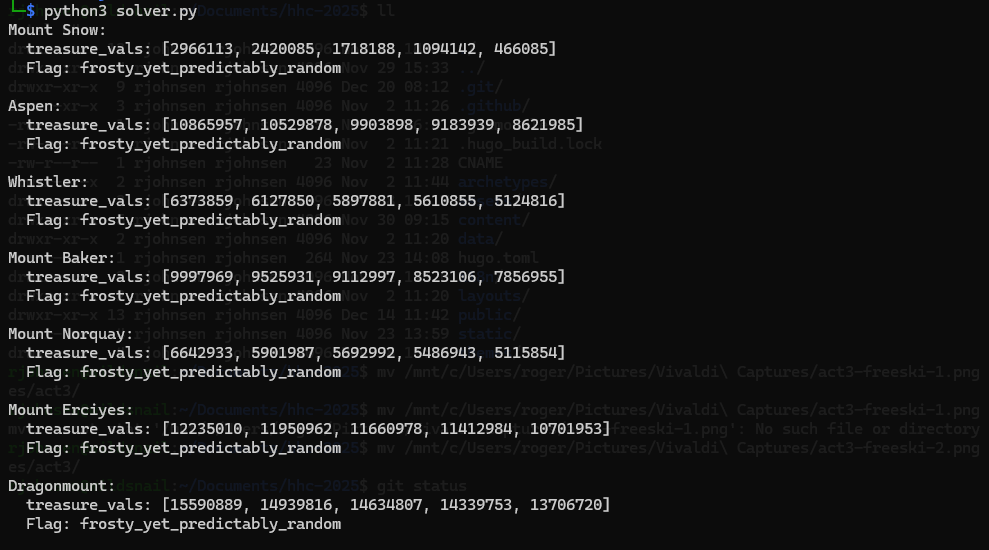
Passphrase is: frosty_yet_predictably_random
Perceived simplicity often masks complexity that only reveals itself through patience and pattern awareness.
Goose Olivia closing words
After solving, Olivia says:
Looks like you found your own way down that mountain… and maybe took a few shortcuts along the way. No judgment here—sometimes the clever path IS the right path. Now I’m one step closer to figuring out my own mystery. Thanks for the company, friend!
Hints
- Have you ever used PyInstaller Extractor?
- Many Python decompilers don’t understand Python 3.13, but Decompyle++ does!